Dear colleagues, partners, innovators and friends of the circular economy,
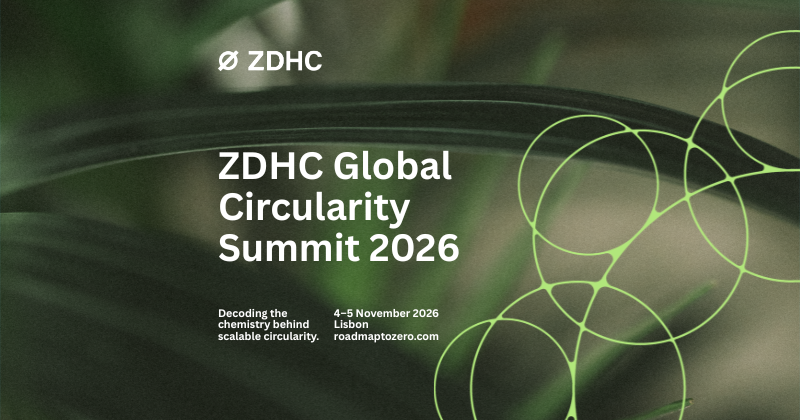
It is a pleasure to invite you to Lisbon on 4 and 5 November for our very first ZDHC Circularity Summit.
Circularity has become one of the defining transformation agendas for our industry. It speaks directly to the future of materials, resources, design, production, business models and consumer behaviour. But above all, it challenges us to rethink how value chains operate - not as linear systems of extraction, use and disposal, but as interconnected systems in which materials retain value, risks are managed responsibly and environmental impact is reduced by design.
At ZDHC, we believe that circularity will only reach its full potential if it is built on a foundation of sustainable chemical management.
The circular economy cannot simply be about keeping materials in circulation. It must also be about ensuring that what we circulate is safe, traceable and fit for future use. If chemicals of concern are allowed to enter materials at the beginning of the value chain, they do not disappear when those materials are recycled. They may remain, accumulate, reappear in secondary raw materials or create barriers to high-quality recycling.
This is why input management matters.
For many years, ZDHC has worked with brands, suppliers, chemical formulators and solution providers to establish a practical and scalable approach to managing chemicals before they enter production. The Manufacturing Restricted Substances List (ZDHC MRSL) is at the heart of this approach. It helps our industry move upstream, from managing pollution after it has occurred to preventing hazardous chemicals from entering manufacturing processes in the first place.
As the circular economy accelerates, we now have to ask a very practical question: how can this input management logic support circularity at scale?
This summit is an opportunity to explore exactly that. Not from the perspective of adding complexity, duplication or another layer of requirements, but from the perspective of making circularity more credible, more scalable and more investable.
Our objective is not to slow down innovation. On the contrary, it helps innovation scale with confidence.
Recyclers, material innovators, brands, manufacturers, chemical suppliers, investors, policymakers, and civil society all share an interest in ensuring that recycled materials are not compromised by legacy or avoidable chemical risks. If we want secondary raw materials to become a trusted part of mainstream production, chemical transparency, risk management, and input control must be part of the circularity infrastructure.
This does not mean that every actor in the circular economy needs to become a chemical expert. It means we need shared systems, a common language, and practical tools that enable the right decisions to be made at the right point in the value chain.
That is where ZDHC can contribute.
Our role is to bring the experience of implementation: the frameworks, the data systems, the supplier engagement, the chemical industry collaboration and the global community needed to make sustainable chemical management operational. We understand that circularity will not succeed through theory alone. It requires workable solutions that suppliers can implement, brands can recognise, chemical formulators can support, recyclers can trust, and regulators can understand.
Lisbon gives us the opportunity to bring these communities together.
The circularity community has developed extraordinary momentum. New recycling technologies, material platforms, fibre-to-fibre solutions, sorting systems, traceability tools and circular business models are emerging rapidly. But to unlock the next phase of progress, we need stronger alignment between circularity and safer chemistry.
We need to avoid a situation in which circularity solves one environmental problem while unintentionally perpetuating another.
That is why the conversation must shift from “Can this material be recycled?” to “Can this material be safely and credibly circulated again and again?”
This is a strategic distinction. Circularity without chemical integrity risks becoming fragile. Circularity with sound input management can serve as a foundation for resilience, resource efficiency, and long-term environmental impact.
I would therefore like to invite the circularity community to engage actively in this summit. Bring your questions, your practical challenges, your experience with innovation, and your honest concerns. This is not about imposing a finished answer. It is about building the right bridges between circular economy ambitions and the operational realities of global value chains.
For ZDHC, this is an important moment. We see circularity, water stewardship, climate, biodiversity and safer chemistry as deeply connected. Better chemistry enables better materials. Better materials enable higher-value reuse and recycling. And higher-quality circularity supports a more resilient and responsible industry.
The task ahead is not small. But it is also not abstract. We know many of the tools. We know the importance of upstream prevention. We know that collaboration is more effective than fragmentation. And we know that the industry needs scalable solutions rather than isolated pilots.
The purpose of this summit is therefore clear: to align, learn, and shape a practical pathway for embedding sustainable chemical management into the circular economy.
I am grateful to everyone joining us in Lisbon and to all those who are willing to help build this agenda. Your participation matters because the circular economy will not be delivered by one organisation, one standard or one technology alone. It will require a community prepared to work together across disciplines, sectors, and the full life cycle of materials.
Let us use this summit to strengthen that connection.
Let us ensure that circularity is not only about keeping materials in use, but about keeping safe, valuable and responsible materials in use.
And let us work together to make safer chemistry a core enabler of the circular economy.
Thank you, and I look forward to the discussions ahead.