By using this website, you agree to the storing of cookies on your device to enhance site navigation, analyze site usage, and assist in our marketing efforts. View our Privacy Policy for more information.
Pushkar Shejwalkar, Technical Manager - Sustainable Chemical Management
(Updated 24 February, 2026)
Why a ZDHC Chemical Watchlist Now?
Sustainability expectations are evolving rapidly, and chemical management is increasingly linked not only to environmental performance, but also to transparency, risk management and regulatory readiness.
In the European Union, frameworks such as the Corporate Sustainability Reporting Directive (CSRD) and the European Sustainability Reporting Standards (ESRS) are raising expectations around how companies disclose impacts, risks and opportunities related to pollution and hazardous substances. Under ESRS E2 (Pollution), companies are expected to report on the use of substances of concern (SoC) and substances of very high concern (SVHCs) within their operations and value chains.
In parallel, the Ecodesign for Sustainable Products Regulation (ESPR) introduces new product transparency requirements, notably through the Digital Product Passport (DPP), which will require information on chemical composition and substances of concern.
Despite this regulatory momentum, the textile, leather, apparel and footwear industry has lacked an industry-specific reference list. As a result, companies have been left to interpret definitions independently, often leading to inconsistent approaches, duplicated effort and uncertainty across complex global value chains.
What the ZDHC Chemical Watchlist Is and What It Enables
The ZDHC Watch List is a non-restrictive, transparency-based, proactive “early-warning layer” to identify substances of concern that can strengthen the ZDHC MRSL update.
ZDHC has led the development of an expert-driven, peer-reviewed ZDHC Chemical Watchlist for the industry to address the gap of the industry-specific reference list.
It is a reference list that identifies substances which may pose a risk to human health, the environment or circularity outcomes. The ZDHC Chemical Watchlist is designed to support informed decision-making, risk identification and transparent reporting across the textile, leather, apparel and footwear value chain.
The ZDHC Chemical Watchlist provides a common reference point that can be applied across different regulatory and voluntary frameworks, supporting alignment and transparency without introducing new requirements or testing obligations.
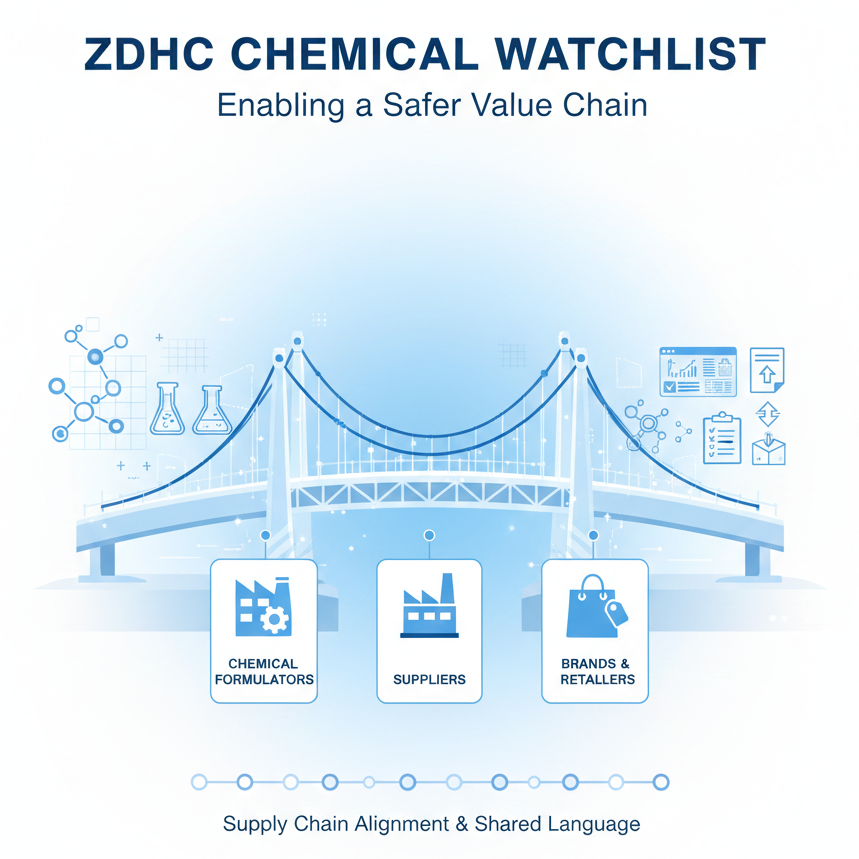
The watchlist functions as a practical bridge between hazard-based science and scalable disclosure. By offering a shared language for identifying substances of concern, it enables organisations to align internal teams and external partners, reduce interpretation risk and support more consistent sustainability and reporting practices.
The Chemical Watchlist and the ZDHC MRSL
A clear distinction is essential. The ZDHC Chemical Watchlist is not the ZDHC Manufacturing Restricted Substances List (MRSL).
The ZDHC Chemical Watchlist does not introduce new restrictions, does not mandate testing and does not create compliance obligations. It is an informational and reporting-focused instrument.
Over time, the watchlist may help inform prioritisation and future ZDHC MRSL development, supporting more aligned and forward-looking chemical management approaches across the industry. Any such linkage reflects long-term ambition rather than immediate change.
Historically, the ZDHC MRSL Candidate List and MRSL Submission Portal have been reactive tools where:
Substances are proposed for restriction
Evidence is submitted by interested parties
The MRSL Council evaluates whether a formal restriction is warranted.
While effective, this model reacts after concerns are already material. The Chemical Watch shifts this logic from reaction to preparedness.
The Chemical Watchlist does not replace the ZDHC MRSL or MRSL Candidate List. Instead of waiting for formal submissions, regulatory bans, or public pressure, the ZDHC Chemical Watchlist allows ZDHC to:
Capture substances of concern earlier
Enable voluntary transparency by stakeholders
Collect implementation insight
Prepare the value chain for possible future transitions.
This turns the ZDHC MRSL Candidate List and MRSL Submission Portal into a decision stage, not a discovery stage, supported by better data and shared understanding.
Who Should Use It and How
The ZDHC Watchlist is not intended for restriction or ban or testing of the substances, but is a system-level, forward-looking transparency mechanism designed to complement the ZDHC MRSL and strengthen ZDHC’s ability to anticipate and manage emerging chemical risks proactively. Support multiple stakeholder groups across the industry, each benefiting in different ways: Chemical formulators: Can better understand industry expectations around substances of concern, anticipate future reporting and substitution needs and align disclosures with brand and market requirements. Suppliers: Can identify substances that may warrant closer attention, initiate risk assessments, explore substitution strategies and support transparent communication with customers. Brands and retailers: Can reference the ZDHC Chemical Watchlist to support transparent reporting (including CSRD- and CSDDD- aligned disclosures), materiality assessments, and product safety strategies, while promoting greater consistency across their supply chains.
Policy makers: Recognise the Chemical Watchlist as a sector-specific contribution to harmonised chemical transparency and reporting.
Use of the ZDHC Chemical Watchlist is voluntary. It does not introduce new requirements, restrictions or compliance obligations. Its value lies in clarity, consistency and credibility.
How the List Was Built: Hazard-Based, Relevant and Expert-Led
The ZDHC Chemical Watchlist is an industry-relevant list of substances of concern for textile, leather, apparel and footwear applications. Importantly, it includes substances that may appear in emissions and is not limited to the scope of the ZDHC Manufacturing Restricted Substances List (MRSL).
ZDHC led the development of the watchlist, defining the methodology, governance and final decision-making process. This work was supported through a co-creative and peer-reviewed process involving technical experts from chemical formulators, brands, NGOs and industry associations.
The development approach combined hazard-based criteria aligned with the ESPR definition of substances of concern, alongside industry-relevance screening specific to textile, leather, apparel, and footwear applications.
Following compilation of a master list of almost 7,000 substances, ZDHC screened for industry relevance, including overlap analysis with standards such as bluesign®, GOTS and OEKO-TEX®. Another 224 substances were identified by analysing Safety Data Sheets (SDS) from the ZDHC Gateway formulation data. The resulting substance set was then reviewed and validated by technical experts to ensure robustness and relevance for textile, leather, apparel and footwear applications.
The result is ZDHC Chemical Watchlist Version 1.0, a provisional list of almost 1,700 substances relevant to the industry, aligned with the ESPR substance-of-concern definition, with additional substances remaining under expert review.
A Foundational Building Block within ZDHC’s Strategy
The ZDHC Chemical Watchlist is not intended to remain a standalone list. ZDHC is working towards deeper integration within the Roadmap to Zero Programme and its associated tools.
The long-term ambition is to enable more structured reporting and performance tracking through ZDHC systems, supporting scalable, data-driven approaches across the value chain. This represents a strategic direction rather than a short-term commitment.
Within ZDHC’s broader CSRD enablement strategy, the ZDHC Chemical Watchlist strengthens the substance-level foundation that underpins credible reporting. It translates regulatory concepts, such as ESRS classifications for substances of concern and substances of very high concern, into operationally usable references, without claiming formal regulatory endorsement.
A Living Reference, Built to Evolve with the Industry
The ZDHC Chemical Watchlist is maintained through a transparent update process, ensuring it remains relevant as science, regulation and industry practices evolve.
The watchlist will be updated regularly to reflect emerging science, regulatory developments and evolving sustainability priorities.
Some substances included may already be phased out or no longer widely used in modern chemistries. These are retained to reflect both historic knowledge and current technologies, providing a long-term reference that supports informed decision-making across the value chain.
Through this approach, ZDHC aims to support safer chemistry, credible transparency and greater alignment across the industry. The ZDHC Chemical Watchlist is voluntary, but designed to be robust enough that others choose to reference, endorse and adopt it, strengthening collective progress across global value chains.

.png)